FPFA Monthly Insights - The Impact of Portfolio Drift on your Financial Objectives (July 2026)
Introduction
In our newsletter last month, we highlighted the evolution of the S&P 500’s top 10 companies over the past several decades. The main takeaways were that change is constant and adaptation is the key to success, which presents an appropriate segway to discuss the concept of “portfolio drift.”
Defining Portfolio Drift and Rebalancing
When the market naturally shifts, the overall asset allocation of an investment portfolio changes in response. As a result, the risk level of your portfolio is directly impacted. Market sectors and asset classes rarely move in unison and there are periods where certain segments outperform others. Your asset allocation could look different over time even though the holdings in your portfolio may not have changed.
For an illustration of portfolio drift in an extremely compact timeframe, look at the market downturn from the first confirmed coronavirus case in the US in January 2020 through the subsequent recovery of Spring 2020. These shifts surprised many investors. A 60/40 portfolio on December 31, 2019, could easily have looked more like a 55/45 portfolio by the end of March 2020 (yellow bar). And, when the markets recovered, a 60/40 portfolio on March 31, 2020, could have looked more like a 65/35 portfolio by the end of June 2020.
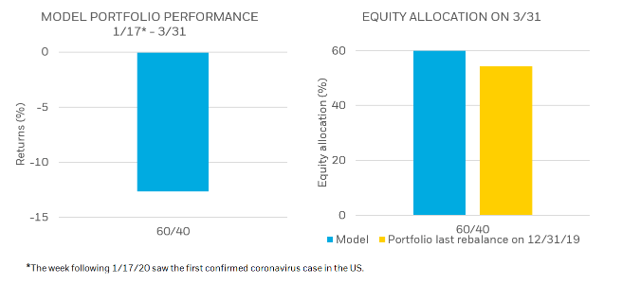
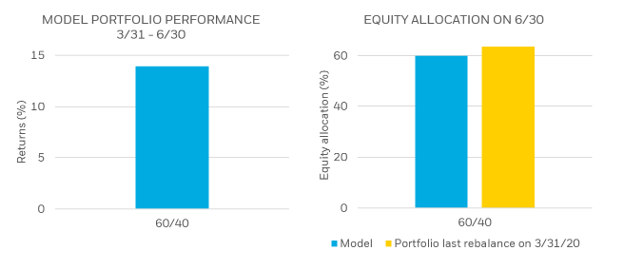
Source: BlackRock
We combat portfolio drift through regular “rebalancing”, which allows us to maintain a target allocation and align an investment portfolio with your investing objectives. Rebalancing establishes a disciplined framework for portfolio management irrespective of predictions of how a market will move. It enables us to keep risk exposure aligned to goals, maintain diversification, and act intentionally during bullish & bearish markets.
Volatility in the market naturally causes discomfort, but it can create opportunities to rebalance thoughtfully and take advantage of market movements. As certain assets become overweight in your portfolio, it presents the opportunity to sell and profit off growth. On the other hand, if some assets in your portfolio become underweighted, it presents the opportunity to “buy low” on underpriced stocks, bonds, or alternatives.
Tax Considerations
It is important to understand that not all rebalancing looks the same, especially as it pertains to taxable vs tax advantaged accounts. For taxable accounts, we do not recklessly rebalance back to a target asset allocation as it could trigger a capital gain. Some capital gain to rebalance and take profit may be in order, but selling a substantial gain on a position could offset the reward of “de-risking” a portfolio through a heavy tax burden. Therefore, we take a careful approach to how we can realign asset allocation without generating excessive taxable income. Rebalancing in tax-advantaged accounts (IRAs, Roths, SIMPLE IRAs, 401(k)s, etc.) gives us more freedom to adjust the asset class mix without triggering capital gains.
How We Can Help
At Front Porch, we are here to help you stay invested during market shifts while working towards achieving your financial goals. By regularly monitoring your portfolio drift, we ensure that your portfolio’s asset allocation aligns with your long-term objectives.
As we move into the second half of the year, it is a great time to examine how your investment portfolio has changed in response to the market to ensure it is aligned with your long-term goals. It is also important to explore if your goals have changed, which is where financial planning conversations come in.
If there are changes to your financial situation or risk tolerance that we should be aware of, please don’t hesitate to reach out to Geoff or myself.
Sources:
https://www.claconnect.com/en/resources/articles/26/portfolio-rebalancing
MONTHLY NEWSLETTER
Front Porch Financial Advisory distributes its ‘FPFA Monthly Insight’ to clients and participants in the retirement plans it advises with the intent of providing information that may be relevant to a broad audience. The content is gathered from various industry resources such as money managers, licensing and education providers, and professionals in fields tangent to wealth management. This material is provided for educational purposes only and does not constitute investment, legal, tax, business, or any other advice. This information is not a substitute for such professional advice or services. Before making any decision or taking any action that may affect you or your personal finances, you should consult a qualified professional advisor.